
The ARMONIA Online Course, part of the project WP3 Capacity Building action, concluded after six weeks of work, marking an important milestone in the project’s efforts to strengthen institutional practices among its Libyan partner universities.
The course began on November 3rd 2025 and ended on December 9th, with the aim to target staff members from ARMONIA Libyan partner institutions who seek to develop their institutional practices through dedicated modules. Each session attracted an average of over 50 participants, demonstrating strong and consistent engagement throughout the programme.
The programme covered the main project themes: quality assurance, internationalisation, mobility, the design of programs, learning objectives and ECTS calculation and innovative teaching practices, in line with the Bologna Process basic principles and major pillars.
Sapienza University of Rome, University of Pavia and Istanbul Aydin University served as trainers, sharing best practices and practical tools to support Libyan colleagues in adopting effective and innovative approaches in their higher education institutions.
The online course aimed to reinforce and complement the knowledge gained during the Staff Training Week held in Istanbul in May 2025, ensuring continuity between face-to-face and online capacity building activities.
Overview of the Online Sessions
The course consisted of three modules, each delivered through two online sessions.
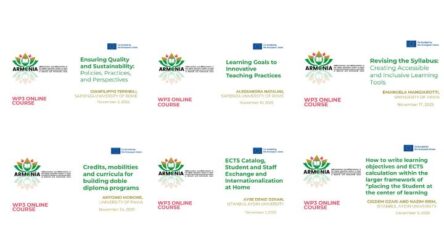
Session 1 – Ensuring Quality and Sustainability: Policies, Practices, and Perspectives| Gianfilippo Terribili, Sapienza University of Rome| 3 November 2025
The opening session focused on the role of quality assurance in higher education. It explained how quality assurance helps institutions deliver high-quality services, attract national and international students and researchers, and maintain strong scientific standards. The session also highlighted how quality assurance supports inclusivity, transparency, and accessibility within the academic community. Participants received practical strategies to strengthen institutional policies and promote sustainable practices.
Session 2– From Learning Goals to Innovative Teaching Practices| Alessandra Natalini, Sapienza University of Rome| 10 November 2025
This session focused on improving academic staff performance in teaching, strengthening the sense of belonging to the scientific community, and transforming traditional teaching and learning methods. It drew on Sapienza University of Rome’s experience with the QuID (Quality and Innovation in Teaching) working group.
Session 3– Revising the Syllabus: Creating Accessible and Inclusive Learning Tools| Emanuela Mangiarotti, University of Pavia| 17 November 2025
This session addressed inclusivity and accessibility as central elements of the Bologna Process and the European Higher Education Area. The discussion focused on mobility, equity, and student-centred learning. Participants examined inclusion and accessibility in line with the Bologna Process and ESG standards, identified barriers in existing syllabi, and co-created a practical checklist for inclusive syllabus design.
Session 4– Credits, Mobilities and Curricula for Building Double Diploma Programmes| Antonio Morone, University of Pavia| 24 November 2025
This session examined the full process of developing double diploma programmes, from designing the curriculum and aligning courses to recognising credits and organising student mobility, providing practical guidance for effective implementation.
Session 5– ECTS Catalogue, Student and Staff Exchange, and Internationalisation at Home| Ayse Deniz Ozkan, Istanbul Aydin University| 1 December 2025
This session examined how institutions can support internationalisation through the ECTS Course Catalogue. The catalogue is an official, publicly accessible document that provides transparent information about institutions, programmes, and courses. It follows ECTS standards to support student mobility, recognition, and quality assurance. The session also addressed student and staff exchange and internationalisation at home.
Session 6– Learning Objectives and ECTS Calculation within a Student-Centred Framework| Cigdem Ozari and Nazim Irem, Istanbul Aydin University| 9 December 2025
The final session focused on ECTS calculation and its role in learning-centred curriculum design under the Bologna Process. The speakers explained what ECTS credits represent and how institutions calculate them. The session also addressed the purpose and structure of well-written learning outcomes. Participants explored Bloom’s taxonomy and reviewed practical examples of learning outcomes aligned with student-centred learning.
Capacity Building as a key for institutional improvement
Capacity building is a fundamental driver of institutional improvement, as it strengthens the skills, resources, and organizational processes that enable institutions to perform their functions effectively. By enhancing both individual and collective capacities, the Capacity Building action of ARMONIA is arriving to its end, supporting decision-making, quality of education, teaching innovation, administrative efficiency, and the ability to adapt to regulatory, social, and economic changes as promoted by the Bologna Process.
After the end of the different training sessions, both in-person and online, the Libyan Institutions will take the lead of the institutional process for the long-term goal of improving their performance and harmonise the Higher Education sector towards more resilient, inclusive and result-oriented sustainable reforms.

